

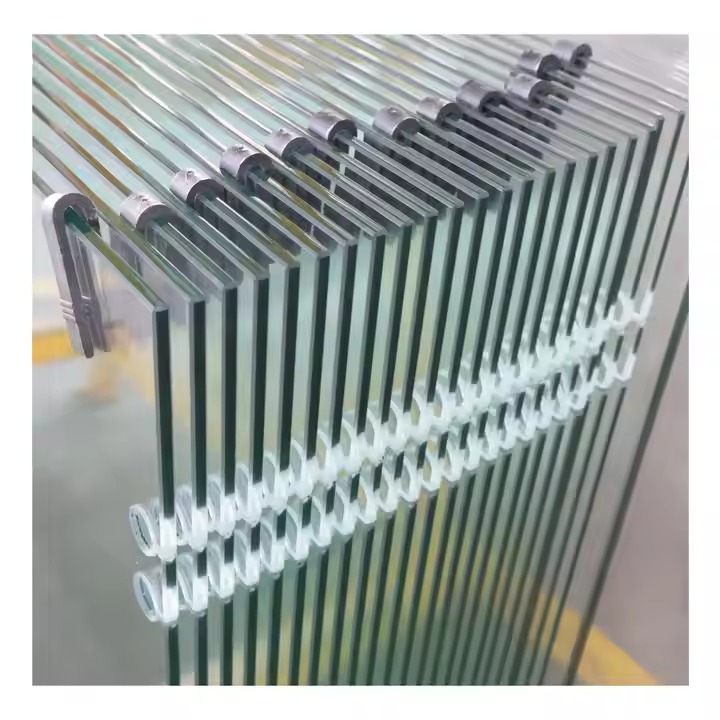
The production of tempered glass is a strict physical heat treatment process. The core of this process is to first heat and then rapidly cool the glass, thereby changing the molecular structure inside the glass. The entire process is usually divided into the following steps:
Cutting and Preparing (Cutting & Edging)
Cutting: Firstly, based on the order dimensions, the large sheets of original glass (usually float glass) are cut into the desired shapes and specifications.
Edge grinding/Drilling: The edges of the cut glass are polished to make them smooth and flat. Depending on the requirements, holes, grooves, etc. can be drilled or machined.
⚠️ Key point: All processing that needs to be done on the glass must be completed before the glass is tempered! Once the glass is tempered, its interior is in a high-stress state. Any attempt to cut or drill will cause the entire piece of glass to shatter into pieces instantly.
Cleaning and Drying
Send the pre-treated glass into the cleaning machine to thoroughly remove all dust, oil stains, fingerprints and other impurities on the surface. Any tiny impurities will be permanently fused onto the glass surface at high temperatures, affecting the quality of the finished product.
Heating
The cleaned glass is sent into the tempering furnace (heating furnace) either horizontally or vertically.
In the furnace, the glass is heated to a temperature near its softening point, typically around 620°C - 650°C. At this point, the glass has not yet melted, but it becomes soft and can be slightly deformed like a syrup.
Quenching (rapid cooling)
This is the core step of the tempering process. Once the predetermined temperature is reached, the glass is quickly removed from the furnace and sent into the cooling device.
Here, the two sides of the glass will be uniformly and rapidly cooled by the high-pressure airflow.
Physical principle: The surface cools rapidly and solidifies and shrinks, while the interior cools more slowly and remains in a soft state. When the interior eventually cools and shrinks, it pulls the already solidified surface inward. This causes a strong compressive stress layer to form on the surface and edges of the glass, while an expansive stress layer is formed inside to counterbalance it.
This stress structure is the fundamental reason for the high strength of tempered glass.
Inspection & Packaging
The cooled glass will undergo various tests, such as size verification, stress spot inspection, and fragment testing (by randomly breaking a piece of glass to check if the fragments are uniform and small particles).
The qualified products were finally carefully packed to prevent scratches and collisions during transportation.
Special Process: Heat Soak Test (HST)
For certain high-standard applications (such as curtain walls, high-altitude lighting roofs, railings, etc.), in order to eliminate the extremely low probability of "self-explosion" risks (mainly caused by nickel sulfide impurities in the glass), a heat soak test is conducted. The tempered glass is placed in a heat soak furnace and heated to around 290°C for a certain period of time, causing the defective glass to break prematurely under controlled conditions, thereby ensuring the reliability of the manufactured products.